
|

|

|
|

|
|



7. Device and Drug Updates
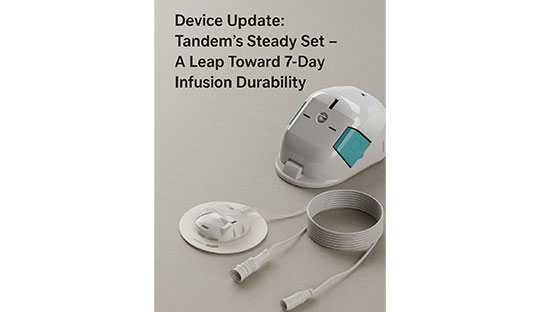
Tandem's Steady Set – A Leap Toward 7-Day Infusion Durability
Tandem Diabetes Care is advancing insulin infusion technology with its upcoming Steady Set, a 7-day infusion set currently under FDA review. Developed in collaboration with Capillary Biomedical, this set aims to extend wear time while enhancing user experience.
Key Features
Extended Wear Time: Designed for up to 7 days of use, the Steady Set features a reinforced cannula to minimize occlusions and maintain insulin delivery efficacy.
User-Friendly Design: The set includes dual activation buttons for one-handed application, catering to individuals with dexterity challenges.
Innovative Cannula Design: The 16 mm cannula is inserted at a 35° angle, which Tandem reports minimizes discomfort and pain, enhancing wearer comfort.
Secure Tubing Connection: The tubing attaches via a push-and-twist mechanism, ensuring a secure connection with minimal effort.
Development and Regulatory Status
Following Tandem's acquisition of Capillary Biomedical in 2022, the Steady Set has been developed to offer a longer wear time compared to traditional infusion sets. While the current FDA clearance is limited to three-day use, Tandem has already confirmed its 7-day wear is with the FDA now for the additional 510(k) clearance needed. The company is holding off on launching the Steady Set until this extended use approval is granted, demonstrating confidence in the product's durability and user appeal.
Market Implications
If cleared, the Steady Set would become the second infusion set on the U.S. market with 7-day wear capability, positioning Tandem as a leader in extended-wear infusion technology.
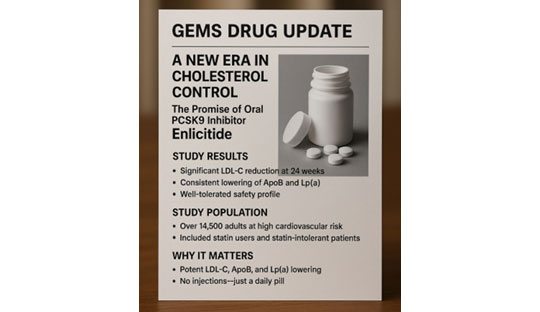
A New Era in Cholesterol Control: The Promise of Oral PCSK9 Inhibitor – Enlicitide
Despite the efficacy of statins and monoclonal antibody-based PCSK9 inhibitors, a substantial proportion of patients remain at high cardiovascular risk due to either statin intolerance or inadequate LDL-C control. Injectable therapies, while effective, present practical limitations related to adherence and accessibility. Enlicitide decanoate, a novel oral PCSK9 inhibitor, emerges as a potential therapeutic innovation poised to address these unmet needs.
Clinical Trial Evidence: CORALreef Lipids Phase 3 Study Outcomes
The CORALreef Lipids trial, a large multicenter, randomized, placebo-controlled Phase 3 study, evaluated the efficacy and safety of enlicitide in over 14,500 adults with hypercholesterolemia and elevated cardiovascular risk, including those on moderate- or high-intensity statins and individuals with documented statin intolerance. As the largest enlicitide trial to date, it demonstrated that the oral PCSK9 inhibitor met all primary and secondary endpoints, showing significant reductions in LDL-C at 24 weeks, along with meaningful decreases in non-HDL-C, ApoB, and lipoprotein(a). Enlicitide was well tolerated, with low discontinuation rates and a safety profile consistent with prior studies, highlighting its potential as an effective and convenient alternative for patients who require more than statin therapy or cannot tolerate it.
Mechanism of Action: Targeted Inhibition of PCSK9 via Oral Macrocyclic Peptide
Enlicitide is a synthetic macrocyclic peptide engineered to bind to PCSK9, thereby inhibiting its interaction with the LDL receptor (LDLR). PCSK9 normally promotes the degradation of LDLRs, reducing the liver's capacity to remove LDL-C from circulation. By blocking this interaction, enlicitide increases LDLR availability at the hepatocyte surface, facilitating enhanced LDL-C clearance. This mechanism mirrors that of monoclonal antibody PCSK9 inhibitors but offers the convenience of oral administration.
Why It Matters
The ability to deliver PCSK9 inhibition via a once-daily oral tablet represents a paradigm shift in lipid-lowering therapy. Enlicitide may significantly improve treatment accessibility and adherence, especially in patients unwilling or unable to use injectables. It offers a viable therapeutic alternative for individuals with statin intolerance and those with residual cardiovascular risk despite maximally tolerated statin therapy.
Integration with Existing Evidence: Positioning Within the PCSK9 Inhibitor Class
The CORALreef Lipids trial adds to a growing body of evidence, including the CORALreef HeFH and CORALreef AddOn trials, which also demonstrated favorable lipid-lowering efficacy. The ongoing CORALreef Outcomes trial aims to assess the long-term impact of enlicitide on major adverse cardiovascular events (MACE), which will be critical for future guideline inclusion and clinical uptake.
Clinical Takeaway
Enlicitide decanoate has the potential to reshape the cholesterol-lowering landscape:
- Potent LDL-C, ApoB, and Lp(a) lowering
- No injections—just a daily pill
- Favorable safety and tolerability
GEMS Perspective
Enlicitide represents a scientific and clinical advancement in lipidology by combining potent LDL-C reduction with oral delivery, thus overcoming a key barrier to PCSK9 inhibitor use. From a GEMS standpoint, enlicitide has the potential to democratize advanced lipid management, bridging the gap between cutting-edge science and real-world feasibility. As regulatory submissions advance and outcome data mature, this molecule may well become a cornerstone in the next generation of atherosclerotic cardiovascular disease (ASCVD) prevention strategies.
For enquiries info@jothydev.net.
Please visit: jothydev.net | research.jothydev.com | diabscreenkerala.net | jothydev.com/newsletter