|

|

|
|

|
|



7. Device & Drug Updates
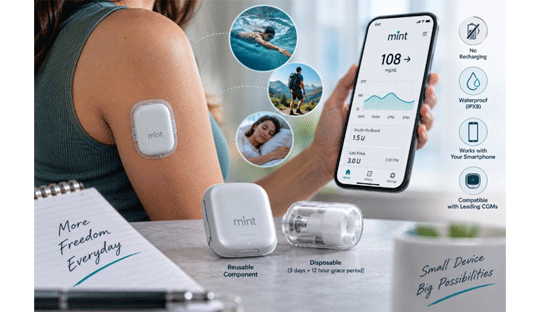
Mint™: A New Tubeless Insulin Pump Moves Toward More Personalized Insulin Delivery
Beta Bionics’ Mint™ has received U.S. FDA clearance as a new tubeless insulin patch pump. Mint uses a two-piece reusable-and-disposable architecture that does not require recharging. The disposable component is designed to provide insulin delivery for 3 days, with an additional 12-hour grace period, and has a 200-unit insulin reservoir. The device also has an IPX8 waterproof rating.
Separately, Beta Bionics is developing Mint 3D™, an investigational automated insulin-delivery system that would combine the Mint pump with the company’s proposed 3D Intelligence™ adaptive insulin-dosing algorithm and compatible continuous glucose monitoring systems. The 3D Intelligence platform has been submitted to the FDA and is designed to offer three algorithm experiences—Original, Optimized, and Conservative—based on individual insulin-delivery needs.
If regulatory clearance is obtained, 3D Intelligence is expected to power both Mint 3D™, the tubeless system, and iLet 3D™, its tubed counterpart. Importantly, Mint 3D™, iLet 3D™, and the 3D Intelligence™ algorithm remain investigational and are not currently available for sale. The full U.S. commercial launch of the FDA-cleared Mint pump is expected in Q1 2027.
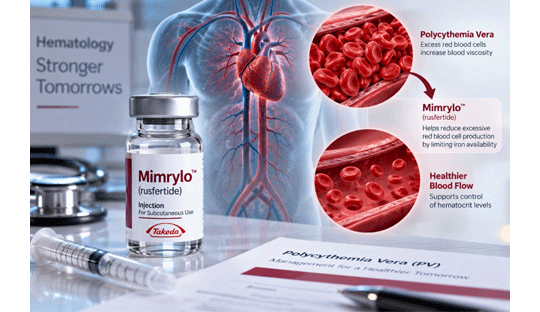
Mimrylo™: A New Treatment for Polycythemia Vera
The U.S. FDA has approved Mimrylo™ (rusfertide), a hepcidin mimetic, for the treatment of erythrocytosis in adults with polycythemia vera. PV is a rare blood disorder characterized by excessive production of red blood cells, which can increase blood viscosity and raise the risk of serious cardiovascular complications, including blood clots, stroke, and heart attack. Mimrylo introduces a novel approach as the first approved treatment for PV that mimics hepcidin, a naturally occurring hormone involved in regulating iron availability. By restricting the amount of iron available for red blood cell production, rusfertide helps reduce excessive erythrocyte production and supports control of hematocrit levels.
A key treatment goal in PV is maintaining hematocrit below 45%, often requiring repeated phlebotomy, in which blood is removed to reduce the excess red blood cell mass. In the phase 3 VERIFY trial, 293 adults with PV who continued to require frequent phlebotomies despite standard therapy received either once-weekly subcutaneous rusfertide or placebo. During weeks 20–32, 76.9% of patients receiving Mimrylo met the response criterion compared with 32.9% receiving placebo. Treatment began at 19 mg weekly and was adjusted to maintain hematocrit below 45%. The most commonly reported adverse reactions were injection-site reactions and anemia. The approval was granted to Takeda Pharmaceuticals America, Inc., following FDA priority review.