
|

|

|
|

|
|



7. Device & Drug Updates
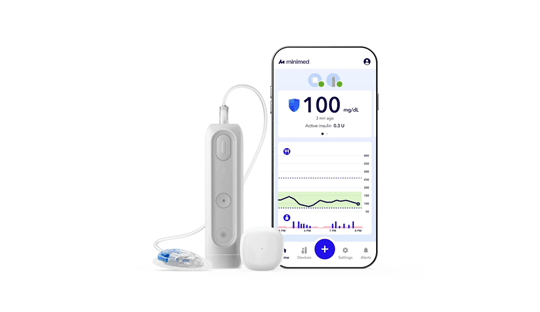
MiniMed™ Flex: A Compact, Screen-Free Insulin Pump for Automated Diabetes Management
Medtronic has introduced the MiniMed™ Flex, a next-generation screenless tubed insulin pump designed to provide discreet, flexible, and user-friendly automated insulin delivery (AID). Approximately half the size of the MiniMed 780G, the MiniMed Flex incorporates the same proven SmartGuard™ AID algorithm while offering a more compact design. It is approved for people aged 7 years and older with type 1 diabetes and adults (18 years and older) with insulin-treated type 2 diabetes.
The MiniMed Flex is controlled entirely through a smartphone application compatible with both iPhone and Android devices, eliminating the need for an onboard display. It is compatible with the Simplera Sync™ CGM and Abbott's Instinct™ CGM, enabling continuous glucose-guided automated insulin delivery. The pump holds up to 300 units of insulin, uses the same cartridges and infusion sets as the MiniMed 780G, and, with Extended Infusion Sets, can be worn for up to seven days before changing the infusion site. A rechargeable battery requires only about 30 minutes of charging once a week, while its IPX8 waterproof rating allows submersion up to 8 feet (2.4 m) for 1 hour and 45 minutes. A simple status button with colored LED indicators provides charging and system alerts, making the MiniMed Flex an attractive option for individuals seeking a smaller, discreet, and smartphone-integrated insulin pump for modern diabetes management.
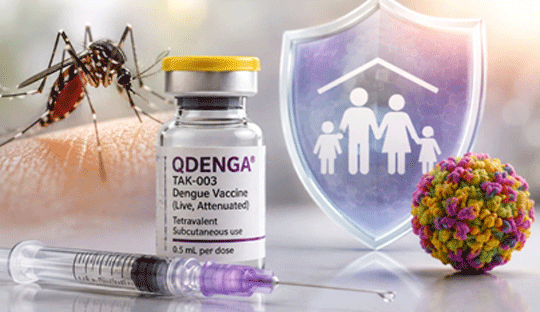
India Approves Its First Dengue Vaccine: Qdenga® (TAK-003)
In a landmark step for dengue prevention, the Central Drugs Standard Control Organisation (CDSCO) has approved Qdenga® (TAK-003), making it the first dengue vaccine approved in India for individuals aged 4–60 years. Developed by Takeda, Qdenga® is a tetravalent live-attenuated vaccine administered as two 0.5-mL subcutaneous doses, 3 months apart. It uses an attenuated DENV-2 backbone to create four chimeric vaccine strains representing DENV-1 to DENV-4, aiming to provide broad protection against all four dengue serotypes. Clinical studies across dengue-endemic regions have demonstrated robust immune responses in both dengue-seropositive and seronegative individuals. Long-term follow-up has shown sustained protection, including 84.1% efficacy against hospitalized dengue at 54 months, with protection observed irrespective of baseline serostatus.
Qdenga® has now been approved in 42 countries, received WHO prequalification, and more than 24 million doses have been distributed globally. Studies have reported substantial protection against severe dengue and hospitalization, while real-world safety findings have remained consistent with clinical trial data. The vaccine also induces dengue-specific immune responses, including cross-reactive NS1 antibodies that may contribute to protection. If the second dose is delayed, the vaccination series does not need to be restarted; the remaining dose can be administered as soon as feasible. India's approval represents an important advancement in dengue prevention, although vaccination should complement, not replace, vector control, surveillance, early diagnosis, and appropriate clinical management.