
|

|
|
|

|
|



6. Snacking Patterns, Diet Quality, and Cardiometabolic Risk in Adolescents: Lessons from NHANES (2009–2016)
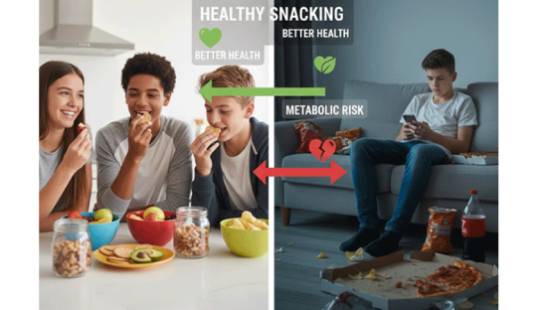
Snacking has become a defining feature of modern eating patterns, especially among adolescents. While snacks can contribute essential nutrients, they may also supply excess calories, saturated fats, added sugars and sodium factors that influence overall diet quality and cardiometabolic health. A new analysis of the National Health and Nutrition Examination Survey (NHANES 2009–2016) sheds light on how different aspects of snacking including frequency, energy density and nutritional quality relate to diet quality and metabolic risk in U.S. adolescents aged 12–19 years. The study highlights how the character of snack choices, rather than snacking per se, plays a meaningful role in shaping eating patterns and health outcomes.
Study Overview and Methods
Researchers analysed nearly 4,000 adolescents (1,999 boys and 1,897 girls) with detailed 24-hour dietary recall data. Each reported eating occasion was classified as a snack or a meal based on participant identification, enabling calculation of:
- Snack frequency: number of daily snack occasions
- Snack energy density (ED): calories per gram of snack foods, analysed with and without beverages
- Snack nutritional quality: assessed using a hybrid nutrient density score that reflects the balance of nutrient-rich versus nutrient-poor foods
Overall diet quality was measured using the Healthy Eating Index 2015 (HEI-2015), a validated composite score reflecting adherence to dietary guidelines. Researchers also examined cardiometabolic health indicators, including waist circumference, fasting blood glucose, triglycerides (TAG), HDL-C, LDL-C, blood pressure and a composite metabolic syndrome risk score.
This comprehensive approach enabled the team to link snack characteristics with both diet quality and early markers of metabolic risk.
Key Findings: Snacks and Diet Quality
The study revealed nuanced relationships between snacking behaviours and overall dietary patterns:
- Snack Nutritional Quality Drives Diet Quality
Across both sexes, higher nutritional quality of snacks meaning snacks richer in vitamins, minerals and other beneficial nutrients was consistently associated with better overall diet quality (higher HEI-2015 scores). Adolescents who chose nutrient-dense snacks tended to eat more fruits, vegetables, lean proteins and whole grains, and fewer processed, energy-dense foods. - Energy Density Matters Higher snack energy density (especially when beverages were excluded) correlated with lower overall diet quality. This suggests that energy-dense snacks, often high in sugars and fats may displace more nutritious choices and skew total intake toward poorer dietary patterns.
- Snack Frequency Shows Complex Associations Contrary to the assumption that more frequent snacking is inherently unhealthy, higher snack frequency was not universally linked with poorer diet quality or metabolic risk. In some cases, especially among girls, more frequent snacking was associated with lower waist circumference and lower fasting blood glucose.
Sex-Specific Patterns in Metabolic Risk
The relationships between snacking and cardiometabolic factors differed between boys and girls:
A few important points elevate this beyond just “diet and exercise help you lose weight”:
- In girls, several favourable associations emerged:
- Higher snack frequency correlated with lower waist circumference and lower fasting glucose, suggesting that nutrient-dense, frequent snacks might help distribute energy intake and avoid large glycaemic excursions.
- Higher snack nutritional quality was associated with lower triglyceride levels, a marker of better lipid metabolism.
- In boys, these patterns were less consistent. Snack characteristics were not strongly linked with waist circumference, glucose, lipids or the composite metabolic risk score, indicating that snacking behaviours may interact differently with sex-specific growth, hormonal milieu and energy demands.
- Dietary guidance for young people should emphasise snack quality, not simply discourage snacking.
- Nutrition education programmes in schools and communities should promote nutrient-dense snacks as healthy alternatives to energy-dense, processed options.
- Clinicians and dietitians should consider snacking patterns when counselling adolescents and families, recognising that reasonable, high-quality snacks can support metabolic health and prevent overeating at meals.
Interpretations and Mechanisms
The findings support several important interpretations:
Snacking can be beneficial or detrimental depending on food quality.
Frequent consumption of nutrient-rich snacks (like fruits, nuts, dairy, whole grains) may improve overall diet quality without adding excess calories, while energy-dense, nutrient-poor snacks can undermine dietary balance and contribute to unhealthy patterns.
Snacking behaviour interacts with adolescent physiology.
Adolescence is a period of rapid growth, hormonal changes and shifting energy needs. Sex-specific differences in associations may reflect divergent metabolic responses to food intake patterns and varying physical activity or growth trajectories.
Early eating habits shape later risk.
Because adolescent snacking contributes substantially to daily energy intake, habitual patterns established during these years may influence lifelong dietary habits and cardiometabolic trajectories.
Public Health and Clinical Implications Given the ubiquity of snacking among adolescents and its substantial contribution to total energy intake, this study suggests that:
Efforts to improve food environments in homes, schools and recreational settings, ensuring that nutrient-rich snacks are appealing and accessible may help shift adolescent dietary patterns toward higher quality and better long-term health.
GEMS Takeaway
Not all snacking is created equal. In U.S. adolescents, snack nutritional quality emerges as a key driver of overall diet quality, and lower energy density snack choices are linked with healthier eating patterns. While frequent snacking is not inherently harmful and may even be associated with certain favourable metabolic markers in girls, the type of snack matters most. Encouraging nutrient-rich, lower-energy-density snacks early in life may help shape healthier dietary habits and reduce cardiometabolic risk across adolescence and into adulthood.
For enquiries info@jothydev.net.
Please visit: jothydev.net | research.jothydev.com | diabscreenkerala.net | jothydev.com/newsletter